

Listening to Everyday Objects
unlearning capitalism, falling in love with the mundane

“Darning a garment can be like a conversation, or like the unfolding of a story between stitches.” -Noriko Misumi, Joyful Mending
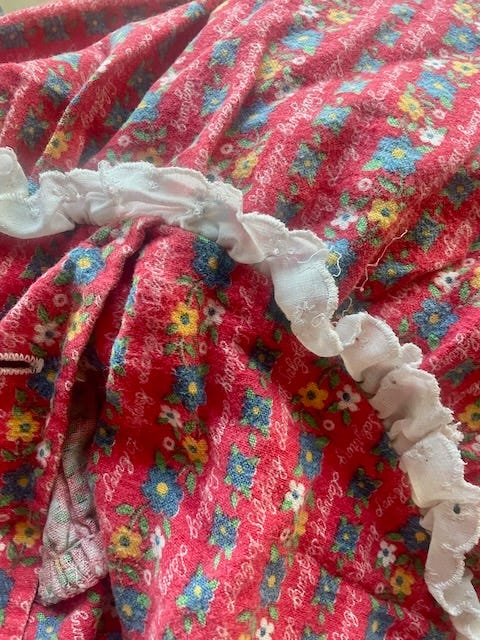
Lately, I spend all day looking forward to sewing time. Once all the chores have been completed, all the leftovers put away, once every dog and family member has settled in their respective zone, I choose a project from my mending pile and sit on the couch with my earbuds and my box of threads and needles.
(Auditory stimulation + fine motor engagement = Heaven.)
I’m trying to learn what to do about holes—how to transform accidents into stories.
It’s part of a new obsession I have, one that’s taken me by surprise, with listening to the objects in my world.
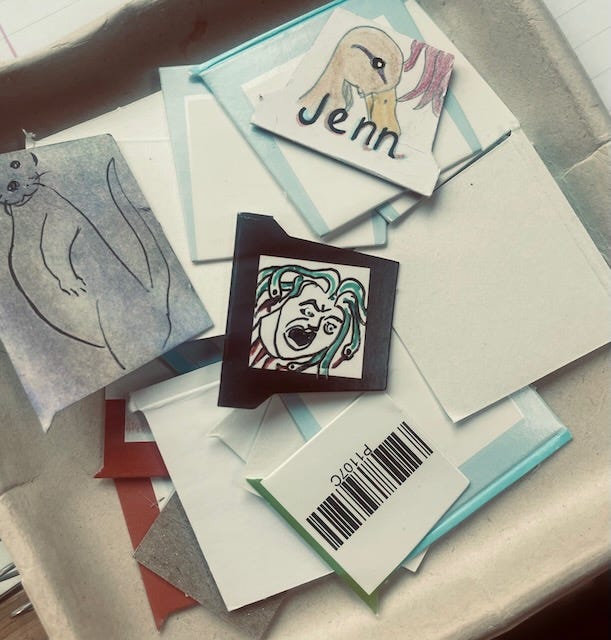
This obsession started when I bought a professional-grade paper cutter off of Facebook Marketplace. I don’t even remember my original intention, but quickly I started deconstructing all the boxes that my family went through daily—the cereal boxes, the cookie boxes, the frozen pizza boxes. Quickly, I became overwhelmed with abundance of supplies in my life. More gradually, I fell in love with the ways that repurposed boxes became collaborators; their shapes or features sometimes suggested a direction.
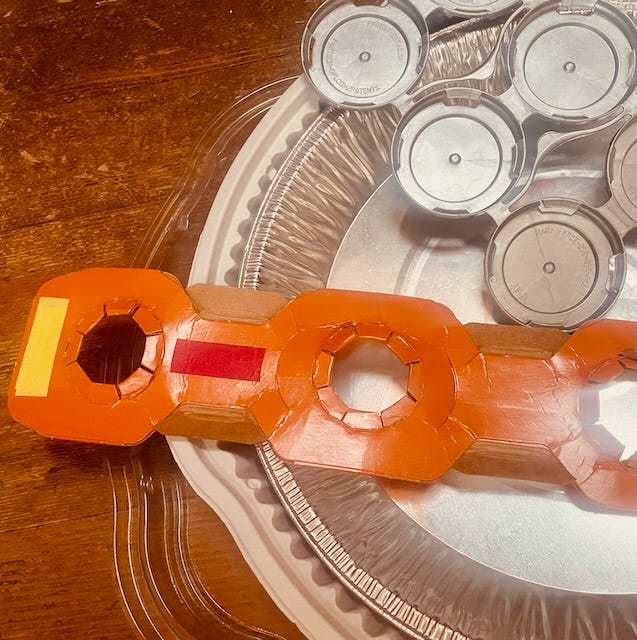
I started collecting other things, like the plastic circles that hold a 6-pack of beer cans together (portals!) or the plastic clam shell container that held a Costco pumpkin pie (a frame?). And, I started wondering why in the past I’ve shopped for containers, when I am SURROUNDED BY CONTAINERS ALL THE TIME.
I’m trying to learn the fine line between being a lover and a hoarder, telling myself that actually, I’m pretty well stocked on boxes for now.
And I’m hoping that this new way of interacting with my world gently leads me towards a new way of being:
being with Home,
being with Money,
being with Memory and Story.
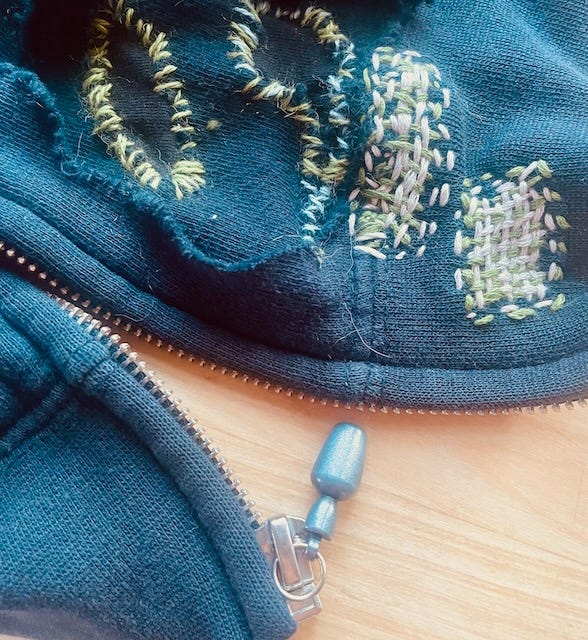
My biggest mending project so far has been a hoodie that I bought for my teenage son some years ago. It was a well-designed hoodie with a fancy zipper. By the time our corgi chewed several holes in it (trying to get to a treat in the pocket), my son was mostly done wearing it. But what does one do with an unwearable hoodie? It was too ripped to donate and I didn’t want to put it in the trash. It might have stayed, along with everything else in my mending pile, for many years, and that is because I’m the type of person who keeps a mending pile even though she has no mending skills. It’s a kind of self-delusion, I know.
Except suddenly, I want to get to know the holes. Suddenly, I’m watching YouTube tutorials on 3 different ways to fix a small hole in a t-shirt.
I want to cut apart a ripped t-shirt and use it to fix a ripped hoodie. I want to wear my teenage son’s cast-off hoodie, transformed by my corgi and then by me, as some kind of protective object.
When I left my full-time job a few years ago, I kept returning to the idea that I wanted a life where I could always wear my farm clothes. I meant it literally. I hate worrying about what I wear. I hate getting dressed. I hate changing. But I also get that there’s an identity component. I want to be one person.
And now, I want to inhabit a world where everything is storied, reclaimed, repurposed.
It feels like a way of gaining distance from capitalism, from colonization, a way of living in relationship rather than owning.
So far, I’ve spent at least six hours mending the holes my corgi chewed in my son’s old hoodie. I’m not done yet, and when I am, I’m not even sure I’ll like the result. (My steep learning curve will be on full display.) BUT, I love how ridiculously inefficient that is.
One of capitalism’s traps is training us to fixate on the relationship between time and money, training ourselves to constantly ask: Is this worth my time?
Is my son’s dog-chewed sweatshirt that he will never wear again worth many hours of my time?
Does the sweatshirt itself “spark joy”?
LOL! A THOUSAND TIMES NO. By all reasonable measures I should have Marie Kondo’d that mending pile years ago.
But then the earth turned on its axis and suddenly YES. The holes spark joy. The possibility of repair sparks joy.
To constantly ask Is this worth my time? is to distract myself from the possibility of Love.
(My love for the object is born of the time spent engaging with the object.)
Which brings me back to where I started. What’s better than a YouTube tutorial? An analog book on mending. I’m enjoying (from my local library), Well Worn by Skye Pennant and Joyful Mending (quoted above and below) by Noriko Misumi. Misumi, who writes about “mending as a way of life,” talks about how flaws can “turn into a source of joy”:
“I think that joy isn’t simply a passive experience of pleasure, but an active participation in the creation of pleasure.”
